

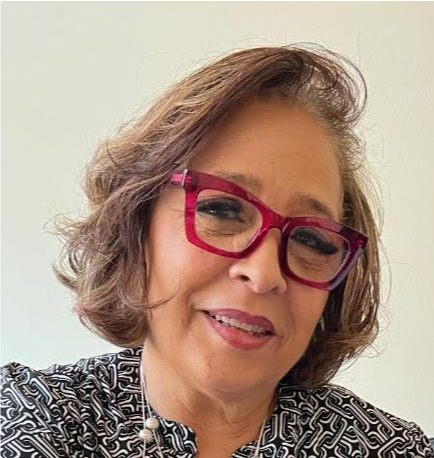
Audra Carter Wilkins
Research Vision Statement
Exploring the intersection of artificial intelligence and inclusive special education.
Research Vision
Statement
By Audra Carter Wilkins
My research vision is shaped by my experiences as a special educator, my academic training at Florida International University, and my lifelong commitment to ensuring that children with disabilities, especially those with Autism Spectrum Disorder (ASD), are given equitable opportunities to learn, grow, and thrive.
I plan to investigate the integration of AI-enhanced instructional tools in early childhood and elementary classrooms serving students with Autism. While digital and adaptive technologies hold great promise, they are often underutilized or implemented without sufficient attention to cultural responsiveness or family engagement. My research will explore how AI-based supports, such as personalized digital schedules, communication systems, and adaptive literacy tools, can be used to improve student learning outcomes while reducing behavioral challenges.
Equally central to my vision is the role of family–school collaboration. Families of students with Autism are often the strongest advocates and most consistent partners in their child’s education, yet they can also encounter barriers to meaningful engagement. I intend to study models that empower families through virtual coaching, culturally responsive strategies, and partnerships that bridge home and school. By centering family voices, my research will contribute to stronger and more inclusive learning environments.
Finally, my vision extends beyond the local context. Issues of global inclusion in special education remain urgent, particularly in regions where resources for children with disabilities are scarce. I aspire to contribute to comparative studies and policy-oriented research that highlight scalable practices for inclusive education worldwide.
Through this research agenda, I seek not only to generate knowledge but also to influence practice and policy. My ultimate goal is to prepare future educators, administrators, and policymakers to create systems where children with disabilities are supported by evidence-based strategies, empowered families, and innovative technologies that respect their individuality.
The Spirit of Innovation: Bridging Artificial Intelligence and the Human Heart in Special Education
Inspired by “The Future of Artificial Intelligence in Special Education Technology” by Matthew T. Marino, Eleazar Vasquez, Lisa Dieker, James Basham, and Jose Blackorby (2023)
In every era of education, there are moments when technology and humanity converge—when invention becomes a reflection of spirit and service. Today, as Artificial Intelligence (AI) emerges as a transformative force in special education, we are reminded that data and algorithms do not just measure progress; they are guided by the compassion and courage that inform their use.
The work of Marino, Vasquez, Dieker, Basham, and Blackorby (2023) envisions AI as a tool not merely of efficiency but of empowerment—a bridge between ability and possibility. Their insights resonate deeply with my own research vision: to ensure that AI does not replace human connection but amplifies it, becoming a compassionate companion to educators, families, and the children they serve.
In my classrooms, I have seen technology transform isolation into communication. A once-silent child finds their voice through adaptive tools. A family once overwhelmed discovers clarity through digital guidance. These moments remind me that technology, when led by empathy, can serve as a spiritual extension of our purpose—to love, teach, and lift others toward their fullest potential.
AI, at its core, is not a replacement for the teacher’s wisdom or the parent’s touch. It reflects our collective intent to understand the diverse ways children learn, to create inclusive pathways that celebrate neurodiversity, and to honor every child’s right to flourish. The research of Marino et al. (2023) calls us to approach AI not with fear, but with reverence—to see it as a cognitive prosthesis that supports the human spirit as much as the human mind.
As I prepare to advance my doctoral studies, I hold close this spiritual truth: innovation without heart is noise, but innovation with compassion becomes light. My research seeks to blend evidence and empathy—to explore how AI-enhanced tools can strengthen family-school collaboration, empower educators to teach inclusively, and illuminate the global promise of special education.
Every child is a divine expression of potential. Every algorithm, when aligned with purpose, can serve that divinity. In this intersection of technology and grace lies our next great chapter, one where data meets soul, and learning becomes an act of healing as much as knowing.
Reference
Marino, M. T., Vasquez, E., Dieker, L., Basham, J., & Blackorby, J. (2023). The Future of Artificial Intelligence in Special Education Technology. Journal of Special Education Technology, 38(3), 404–416.